

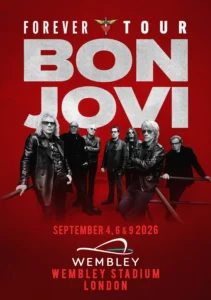
I first saw Bon Jovi live at the old Wembley Stadium in 1995. They were touring around the release of Cross Road, their now-iconic greatest hits collection, which also introduced a little song called Always. I believe that one did reasonably well…
It was quite a supporting bill that day too. Van Halen were there, with Sammy Hagar behind the microphone and Eddie Van Halen returning after his hip injury, if memory serves. Ugly Kid Joe were also on the bill, alongside Crown of Thorns, one of the bands doing their best to keep melodic rock alive through the much tougher musical landscape of the 1990s.
I was already a massive Bon Jovi fan by then, having grown up listening to them throughout the 1980s, but seeing them live for the first time took that obsession to another level. More than three decades later, they remain one of my favourite hard rock bands.
Over the years, I’ve followed plenty of their Wembley history too. I was there for their final show at the old stadium and remember Jon talking about wanting to be part of the reopening of the new Wembley, only for George Michael to get the nod at the last minute. Bon Jovi subsequently headed to Milton Keynes Bowl, with Nickelback joining them on the bill.
There was also the O2 residency, a headline appearance at the Isle of Wight Festival and, most recently, their 2019 show at Coventry’s Ricoh Arena. At the time, I genuinely believed that might be the last time I would ever see Bon Jovi live.
That Coventry show had been a family day out, the three of us watching the band run through the classics and a few personal favourites. But there was an obvious question hanging over the performance: what was happening to Jon’s voice?
We now know the story. The subsequent years brought the Thank You, Goodnight: The Bon Jovi Story documentary on Disney+, Jon’s vocal cord surgery and a very public road back towards performing live. For a while, it seemed entirely possible that we had witnessed the end of Bon Jovi as a touring band.
Then came Forever. The title perhaps offered a little clue that the story wasn’t quite finished. A tour was announced, albeit on a considerably smaller scale than the huge worldwide campaigns Bon Jovi have been known for. There were shows at Madison Square Garden, dates in Ireland and Scotland, and three nights at Wembley Stadium.
We went along on the Sunday, the second of those three Wembley shows and, importantly, the second-to-last night of the tour. The early reports had been encouraging. Perhaps, after everything, this really was the Bon Jovi we had all hoped might return.
James Bay opened the evening, which was something of a left-field choice for a Bon Jovi show. He isn’t exactly renowned for hard rock, although he had contributed Legendary to the Deluxe Edition of Forever. By the time I’m writing this, James had also managed to break his ankle playing football and subsequently performed the third Wembley show seated on a chair with his leg in plaster. A proper professional effort!
Then came the moment everyone had been waiting for.

Bon Jovi appeared from the rear of the stage and Wembley erupted. Before a single note had been played, the band simply stood there, smiling and taking in the reception from more than 80,000 people. It was a genuinely emotional moment. None of us knew if we would ever see this again, and suddenly, there they were.
The obvious question was how would this compare with Coventry in 2019?
The answer, ultimately, is that Bon Jovi has become a band where the whole really is greater than the individual parts.
Jon calls them the “Magnificent Seven” and, looking at the current line-up, it’s hard to argue. Phil X and Hugh McDonald have been integral parts of the live band for years. John Shanks brings another layer to the guitars, while Everett Bradley adds an enormous amount of rhythm, soul and groove alongside Tico Torres. David Bryan remains the wizard behind the keyboards.
There are three original members, two musicians who have been firmly established on stage with the band for years, and another who has worked closely with Jon across numerous albums. Put it all together and there is an impressive, cohesive unit up there.

In terms of the show itself, there were few surprises. This was Bon Jovi doing what Bon Jovi do best. The audience sang at every opportunity, the atmosphere was enormous and the relatively straightforward stage production worked perfectly within the vast surroundings of Wembley.
And then there was the setlist.
Few bands can put together a collection of songs quite like this. Livin’ on a Prayer is approaching its 40th anniversary, which inevitably means the original members are now in their sixties. Expectations have to reflect that reality. This isn’t 1986 anymore, and pretending otherwise would do the band a disservice.
What matters is what the seven people on that stage can deliver now.
The answer was, for the most part, superb.
Every member contributed vocally and instrumentally, and there was a real sense that everyone understood their role in making the show work. The newer material also sat comfortably alongside the classics. This House Is Not for Sale was a particular highlight, with Wembley joining in loudly enough to produce the familiar “Domin-oh-oh-oh” refrain.
Then came Bed of Roses.
Suddenly, strangers sitting along our row were singing together as though we’d been friends for years. We’d only been sitting next to each other for a couple of hours, but none of that mattered. That’s what a Bon Jovi concert does. Tens of thousands of people arrive as individuals and, for a few hours, become part of the same thing.
And that feeling carried through the entire evening.
If Jon had moments where the vocals weren’t quite where they once were, the rest of the band were there to support him. Rather than highlighting any limitations, their teamwork helped turn those moments into another demonstration of why this particular line-up works.
The real evidence came towards the end.
It’s My Life, Livin’ on a Prayer and Raise Your Hands arriving one after another was the sort of run that, a few years ago, might have seemed completely unrealistic. Yet here we were, with the band clearly enjoying themselves and Jon smiling throughout.
That smile said plenty.
These concerts aren’t simply about giving the fans what they want. They feel like they’re important to Jon too. After everything he has been through, standing on that stage at Wembley and hearing tens of thousands of people singing his songs back at him must have been quite something.
I’ll Be There For You produced another huge response from the crowd before the evening eventually reached its final song.
And then Wembley did what Wembley does.
“Alwaaaaaayyysssss…”


As the final notes rang around the stadium, there was a feeling that something had been put right. Whatever memories we had carried away from Coventry in 2019, this show replaced them with something much more positive.
Bon Jovi weren’t simply back for a nostalgic run of shows. They had fought their way back onto a stage that many of us thought they might never occupy again.
It wasn’t the Bon Jovi of 1986, 1995 or even 2019.
It was Bon Jovi in 2026 — seven musicians, still standing, still playing, still smiling and, most importantly, still capable of making a stadium full of people feel like one enormous family.
Welcome back, guys.
Welcome back.
